
Amara was 15 when her family married her off to a stranger twice her age.
It wasn’t tradition that sealed her fate. It was drought. In Narok County’s arid plains, where the worst drought in 40 years has devastated pastoral communities, her family’s animals died within months. With no goats, no camels, no means of survival, they made a calculation: three camels and two goats in bride price, or watch their children starve.
It wasn’t a choice. It was arithmetic born of environmental collapse.
Today, Amara is one of thousands of girls in Kenya’s northern regions whose childhoods were traded for survival. Her story represents a pattern we see across Narok—cases where climate catastrophe doesn’t just cause droughts. It weaponizes gender inequality and turns girls into economic survival tools.
Amara’s story is composite, drawn from documented cases and patterns reported by aid organizations, health workers, and girls themselves across many pastoral communities in Kenya.
When Drought Becomes a Gender Crisis
We don’t often talk about climate change in terms of gender. But in Narok, the connection is impossible to ignore.
For firsthand reporting on this crisis, watch this powerful documentary on how climate collapse is driving gender-based violence in pastoral Kenya:
📹 Watch: Climate Crisis and Gender Violence in Kenya
Climate change is not a neutral force. It hits hardest those who have the least power to protect themselves. In pastoral communities, that means girls and women.
The Four Ways Climate Crisis Becomes a Gender Crisis
1. The Bride Price Economy Activates During Drought
When livestock die and fields dry up, families face an impossible choice: watch their children starve, or secure immediate resources. Child marriage becomes a financial transaction. In communities experiencing 9+ months of no rain, child marriage rates spike dramatically. Girls are exchanged not because of culture, but because of desperation. They become survival currency.
2. Water Collection Becomes a Gauntlet
Girls walk 8.6 to 17.6 kilometers daily to collect water—38 percent more than the three-year average. On these solitary journeys through remote, sparse landscape, they are completely defenseless. Sexual predators know girls will come alone. They wait. We have documented cases of serial rape during water collection journeys. The perpetrators disappear into the desert, facing no consequences.
For detailed reporting on this crisis, read: Al Jazeera: “In Kenya, girls are sold into marriage to stave off starvation from drought”
3. School Becomes a Luxury Girls Can’t Afford
When a girl must walk 8.6 kilometers for water each day, school becomes impossible. Period poverty compounds the crisis—without sanitary pads, many girls won’t attend school during menstruation. When drought hits, water collection takes priority. Girls drop out. Education becomes a privilege reserved for communities with water security.
4. Malnutrition and Health Collapse Hit Girls Last and Hardest
Women and girls typically eat last in pastoral communities. During drought, this means they often don’t eat at all. Malnutrition weakens their bodies and their ability to resist disease, pregnancy complications, and sexual violence. Their health becomes collateral damage in the fight for family survival.
“The last drought took all of our animals. My youngest son became very sick from malnutrition. I was so worried that he would die. It made us much poorer, and now we are in another one which looks like it could be even worse.”
How Tree for Girls Project works
At Tareto Africa, we were already working on sexual and reproductive health and rights with girls in Narok. We were teaching about gender-based violence, harmful practices, and bodily autonomy.
But we kept hitting the same wall: girls couldn’t prioritize their rights when their survival was threatened.
A girl can’t focus on education when she’s walking 8.6 kilometers for water. She can’t resist marriage when her family is starving. She can’t report sexual assault when she’s afraid her report will bring shame to a family already on the brink.
We realized: we couldn’t fight gender inequality without fighting the environmental collapse that weaponized it.
That’s when Trees for Girls was born.
Trees for Girls: An Integrated Approach
Trees for Girls isn’t just about planting trees. It’s about linking three interconnected crises and tackling them simultaneously.
Pillar 1: Environmental Conservation
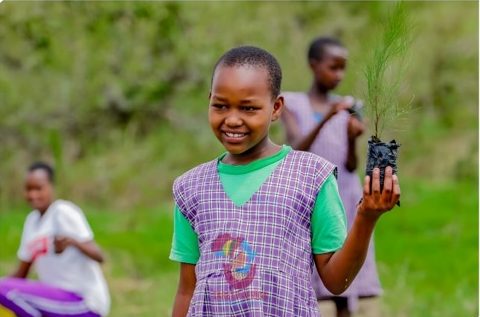
Girls aren’t passive observers of environmental collapse—they’re agents of restoration. Through the program, girls plant trees, practice agroforestry, and implement water conservation techniques. They restore vegetative cover, combat soil erosion, and build long-term community resilience.
But here’s what matters most: girls see themselves as environmental leaders, not victims of environmental disaster. They understand that the droughts that threaten their futures aren’t inevitable. They’re consequences of deforestation and environmental degradation that can be reversed through collective action.
Pillar 2: SRHR Education and Climate Awareness
Comprehensive sexuality education isn’t enough if girls don’t understand why harmful practices intensify during climate stress. So we teach the connection explicitly.
When a girl learns that child marriage spikes during drought, she stops seeing it as cultural tradition and recognizes it as a preventable consequence of environmental collapse. When she understands that sexual violence increases because girls walk farther for water, she becomes an advocate for water security as a feminist issue.
Knowledge becomes power. Understanding the “why” transforms girls from passive victims into active advocates.
Pillar 3: Menstrual Health and Economic Empowerment
We distribute reusable sanitary pads and train girls to produce them. This addresses immediate period poverty—keeping girls in school—while building economic skills that create an alternative to the bride-price economy.
When a girl can earn income through pad production, her family doesn’t need to marry her off to survive. When she can afford pads, she stays in school. When she’s in school, she builds the education and confidence to imagine futures beyond early marriage.
What We’ve Built So Far
2,459+
Girls Reached
5
Partner Schools
100k+
Trees Goal
Our Partner Schools: Where the Movement Grows
Trees for Girls is active in five anchor schools across Narok County, each one becoming a hub of environmental leadership and gender advocacy:
🌱 Nkoilale Primary School
Home to one of our most active T4G clubs, where girls are leading tree-planting initiatives in the surrounding community and training younger students.
🌱 Ntulele Primary School
Girls here are both learning SRHR education and implementing water conservation techniques that benefit their school and neighboring villages.
🌱 Naboisho Primary School
A center of innovation where T4G clubs are experimenting with agroforestry practices and mentoring girls from pastoral families about alternatives to early marriage.
🌱 Masai Girls School
Our secondary school partner, where older girls are trained as peer educators and environmental champions, taking the T4G message to their families and communities.
🌱 Additional School Partners
We are expanding into one additional school, piloting new models and preparing for our scaled expansion to 25 schools.
In just a few years, we’ve established thriving T4G clubs in these schools across Narok. Girls are planting trees. They’re learning about their bodies and their rights. They’re becoming community advocates who understand that environmental justice and gender justice are inseparable.
We’re seeing it: trained girls return to their communities as change agents. They talk to peers about the climate-gender link. They inspire their families to support reforestation. They model confidence and leadership that challenges traditional gender roles.
Each school becomes a nucleus—not just for environmental action, but for a complete reimagining of girls’ possibilities in pastoral communities.
Why We Need to Scale—Urgently
Every year, droughts return. Every year, more girls are married off. Every year, more forests disappear and less water flows.
We can scale this model. We need to.
Our Goal: Expand from 5 to 25 partnering schools. Establish a tree nursery capable of producing 100,000 trees. Reach 3,000+ more girls with integrated climate, SRHR, and economic empowerment training. Create a network of young women who are both environmental stewards and rights advocates—transforming their communities from the ground up.
Every new school multiplies the impact. Every tree planted is a barrier against the next drought. Every trained girl becomes a climate and gender champion.
A Different Future?
Amara’s story—and the thousands like it—doesn’t have to be Narok’s future. But it will be—unless we act now to address the interconnected crises of climate change and gender inequality.
Trees for Girls shows that there’s another way. A way where girls aren’t casualties of climate crisis. Where they’re leaders of climate solutions. Where environmental restoration and gender justice aren’t competing priorities—they’re the same movement.
This is the story we’re writing in Narok. Will you help us keep writing it?